Why Temperature Conversion Requires More Than Just Multiplication
Learn the mathematical difference between ratio and interval measurement scales, why temperature requires affine offsets, and how to convert Celsius, Fahrenheit, and Kelvin.
Unit Converter
Convert length, mass, temperature, area, speed, and volume units instantly with precision.
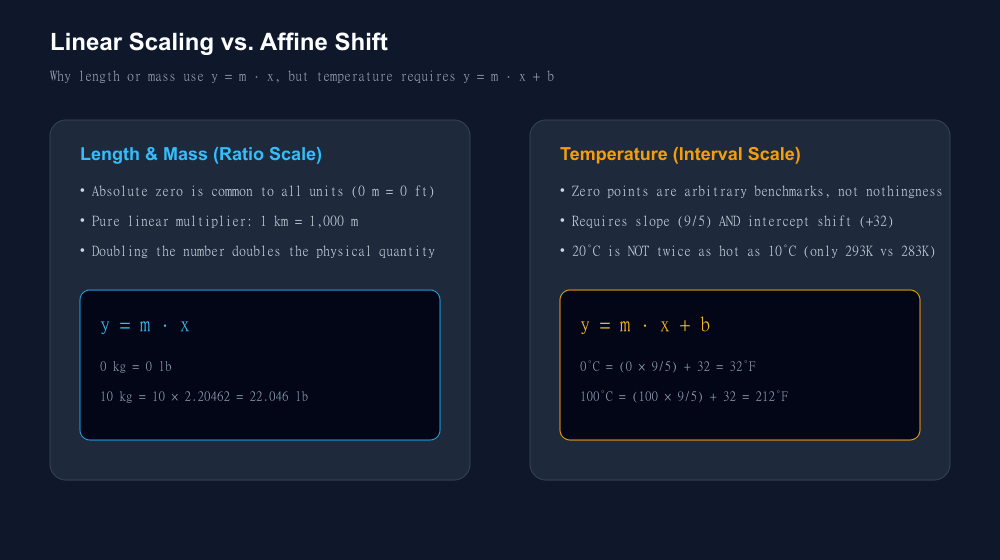
When you convert units of length, mass, time, or speed, the math is straightforward. If you want to convert kilometers to miles, you multiply by approximately 0.621371. If you want to convert kilograms to pounds, you multiply by approximately 2.20462. In almost every daily measurement category, converting unit $A$ to unit $B$ is a pure scalar multiplication:
$$y = m \cdot x$$
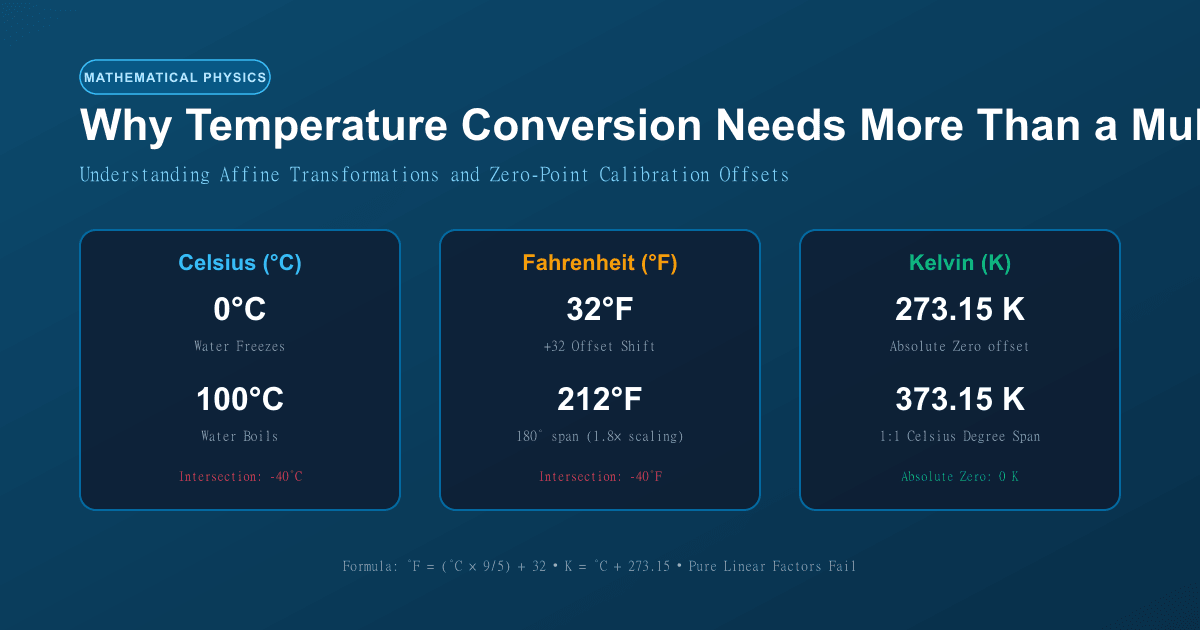
However, the moment you attempt to convert temperature—such as degrees Celsius ($^{\circ}\text{C}$) to degrees Fahrenheit ($^{\circ}\text{F}$)—that simple multiplication breaks down completely. Multiplying $0^{\circ}\text{C}$ by any constant factor still gives zero, yet water freezes at $32^{\circ}\text{F}$.
Temperature conversion requires more than multiplying by a factor. It requires an affine transformation that accounts for both differing step sizes and shifted zero baselines.
In this article, you will learn the physical and mathematical reasons behind temperature offsets, explore the "twice as hot" fallacy, and discover how modern calculation engines like the UtilityKit Unit Converter handle multi-category conversions accurately.
Ratio Scales vs Interval Scales: The Origin of the Shift
To understand why temperature is unique, we must consult the theory of measurement scales developed by psychologist and psychophysicist S. S. Stevens. Physical units fall primarily into two categories:
1. Ratio Scales (Absolute Zero)
Ratio scales possess a true, non-arbitrary physical zero point.
- $0\text{ meters}$ represents the absolute absence of length.
- $0\text{ kilograms}$ represents the absolute absence of mass.
- $0\text{ seconds}$ represents zero elapsed duration.
Because the zero point is absolute and universally shared, ratios are mathematically meaningful. An object measuring $4\text{ meters}$ is objectively twice as long as an object measuring $2\text{ meters}$. Converting between any two ratio units requires only a single scaling constant $m$:
$$\text{Length}_{\text{feet}} = \text{Length}_{\text{meters}} \times 3.28084$$
2. Interval Scales (Arbitrary Zero)
Interval scales measure differences between points, but their zero point is chosen arbitrarily by humans for convenience rather than representing the complete absence of the physical quantity.
- $0^{\circ}\text{C}$ does not represent the absence of heat; it is simply the temperature at which pure water freezes at standard atmospheric pressure.
- $0^{\circ}\text{F}$ was defined by Daniel Gabriel Fahrenheit in 1724 as the freezing temperature of an engineered brine solution of water, ice, and ammonium chloride.
Because $0^{\circ}\text{C}$ and $0^{\circ}\text{F}$ represent different thermodynamic energy states, their graphs do not pass through the coordinate origin $(0, 0)$.
The Affine Transformation Equation
In linear algebra, a transformation that preserves points, straight lines, and planes while including a translation (shift) is called an affine transformation:
$$y = m \cdot x + b$$
Where:
- $x$ is the input temperature.
- $m$ is the relative step size (scaling factor).
- $b$ is the baseline offset (y-intercept).
Deriving the Celsius to Fahrenheit Formula
- Water freezes at $0^{\circ}\text{C}$ and $32^{\circ}\text{F}$.
- Water boils at $100^{\circ}\text{C}$ and $212^{\circ}\text{F}$ (at sea level).
- The temperature difference between freezing and boiling is:
- On Celsius: $100 - 0 = 100\text{ degrees}$
- On Fahrenheit: $212 - 32 = 180\text{ degrees}$
To determine the step size factor $m$: $$m = \frac{180}{100} = \frac{9}{5} = 1.8$$
To determine the offset $b$, evaluate at $x = 0^{\circ}\text{C}$: $$\text{Fahrenheit} = (1.8 \times 0) + b = 32 \implies b = 32$$
Thus, the complete affine formula is: $$T(^{\circ}\text{F}) = \left( T(^{\circ}\text{C}) \times \frac{9}{5} \right) + 32$$
To reverse the conversion from Fahrenheit to Celsius, we subtract the offset before scaling: $$T(^{\circ}\text{C}) = (T(^{\circ}\text{F}) - 32) \times \frac{5}{9}$$
Kelvin and Rankine: Returning to a Ratio Scale
Physicists and thermodynamic engineers avoided affine headaches by inventing absolute temperature scales:
- Kelvin ($\text{K}$): Extrapolates the Celsius degree size down to the theoretical point where all molecular kinetic motion ceases (Absolute Zero).
$$T(\text{K}) = T(^{\circ}\text{C}) + 273.15$$
- Rankine ($^{\circ}\text{R}$): Extrapolates the Fahrenheit degree size down to absolute zero.
$$T(^{\circ}\text{R}) = T(^{\circ}\text{F}) + 459.67$$
Once converted to Kelvin or Rankine, temperature behaves as a true ratio scale! At $0\text{ K}$, thermal energy is truly zero.
The "Twice as Hot" Fallacy
Imagine a local weather broadcast reports:
"Yesterday it was $20^{\circ}\text{C}$ ($68^{\circ}\text{F}$). Today it is $40^{\circ}\text{C}$ ($104^{\circ}\text{F}$), so it is twice as hot outside!"
While $40$ is numerically double $20$, the claim that the atmosphere is "twice as hot" is completely false in physics:
- $20^{\circ}\text{C} = 293.15\text{ K}$
- $40^{\circ}\text{C} = 313.15\text{ K}$
The actual ratio of molecular kinetic energy in the air is: $$\frac{313.15}{293.15} \approx 1.0682$$
A rise from $20^{\circ}\text{C}$ to $40^{\circ}\text{C}$ is merely a $6.8\%$ increase in thermal kinetic energy, not a $100\%$ increase!
Furthermore, if you performed the same calculation in Fahrenheit:
- Yesterday: $68^{\circ}\text{F}$
- Today: $104^{\circ}\text{F}$
- $\frac{104}{68} \approx 1.529$ ($53\%$ increase).
The fact that different scales yield wildly contradictory ratios proves that calculating multiplication factors or percentage increases directly on interval scales is mathematically invalid.
How Unit Converters Model Conversions in Code
In a software utility like UtilityKit's Unit Converter, units are categorized into either standard scalar groups or affine groups:
interface UnitDefinition {
  id: string;
  label: string;
  // Standard ratio scale: conversion factor to base unit
  toBaseFactor?: number;
  // Affine scale: explicit forward and reverse functions
  toBase?: (val: number) => number;
  fromBase?: (val: number) => number;
}

const celsius: UnitDefinition = {
  id: "celsius",
  label: "Celsius (°C)",
  // Base unit is Kelvin
  toBase: (c) => c + 273.15,
  fromBase: (k) => k - 273.15,
};

const fahrenheit: UnitDefinition = {
  id: "fahrenheit",
  label: "Fahrenheit (°F)",
  toBase: (f) => (f - 32) * (5 / 9) + 273.15,
  fromBase: (k) => (k - 273.15) * (9 / 5) + 32,
};
By routing every temperature through a common absolute baseline (Kelvin), the converter can seamlessly convert between Celsius, Fahrenheit, Kelvin, and Rankine in $O(1)$ constant time with full floating-point precision.
Convert Units Instantly with UtilityKit
Whether you need to convert temperatures for laboratory chemistry, calculate structural loads between metric and imperial systems, or convert data storage sizes and speeds, test our free Unit Converter. It features live two-way conversions, instant swap buttons, and mathematically verified formulas across eight comprehensive measurement categories.
Frequently Asked Questions
Quick answers to common questions for users and search assistants
Why can't I convert Celsius to Fahrenheit using a single multiplication factor?
Why is 40°C not twice as hot as 20°C?
What is an affine transformation in measurement systems?
Related Utilities Mentioned in This Guide
Browse directoryUnit Converter
Convert length, mass, temperature, area, speed, and volume units instantly with precision.
Base64 Encoder & Decoder
Encode and decode Unicode text, UTF-8 strings, and files to and from Base64 format.
LaTeX Source Editor
Write, copy, and download .tex files; PDF compilation is temporarily unavailable.
Continue Reading
Base64 Encoding vs Encryption: Why Obfuscation Is Not Security
Understand the mathematical difference between Base64 data representation and cryptographic encryption, how 6-bit grouping works, and how to encode safely.
How to Fix LaTeX Compile Errors and Debug Documents Fast
Learn to read TeX error logs, find the source line, fix common package and syntax errors, and ask an AI assistant for a corrected document.